
At London Climate Action Week, WCF and pladis explore regenerative agriculture, resilient cocoa supply chains, farmer support and collaboration across the sector.
Suzanne Blake, Head of Strategic Partnerships and Membership, World Cocoa Foundation WCF, in conversation with Suzanne Westlake, Global Sustainability Director at pladis
At London Climate Action Week, the NAT roundtable “From Margins to Mainstream: Scaling Regenerative Agriculture” brought together voices from business, farming, finance, science and supply chains to discuss what it takes to move regenerative agriculture from promising practice to wider adoption.
Following the discussion, Suzanne Westlake, Global Sustainability Director at pladis, and Suzanne Blake, who leads membership engagement at the World Cocoa Foundation, reflect on what this means for food supply chains and for cocoa.
Suzanne Blake, WCF:
A key priority for WCF is helping the cocoa sector move beyond individual programmes towards greater alignment, shared learning and impact at scale. Companies often face similar barriers, even when they operate across different supply chains and origin countries. From the discussion at London Climate Action Week, what needs to change for regenerative agriculture to move from promising practice to wider adoption?
Suzanne Westlake, pladis:
The biggest change needed is a shift from transactional relationships to genuine partnerships. This was the point that landed most strongly for me: no business can make regenerative agriculture work from a conference room. It has to be shaped with the people who understand the land, the crop and the economics of farming.
Regenerative agriculture is key to resilient cocoa
Suzanne Blake, WCF:
At the 2026 WCF Partnership Meeting, resilience was framed as a shared challenge that connects farmers, landscapes, markets and long-term supply. Regenerative agriculture is often discussed as a sustainability concept, but from a company perspective, why does it matter now?
Suzanne Westlake, pladis:
For us at pladis, regenerative agriculture goes beyond a sustainability concept. It is about the future resilience of the ingredients behind some of the products people know and love. If the farms we depend on are facing soil degradation, biodiversity loss, extreme weather and more volatile costs, that has direct implications for the long-term security of our supply chains, as well as for the environment.
We also have to be clear that farmers are already navigating a lot of change. The question for companies like ours is how we make that transition practical, credible and commercially meaningful, rather than asking growers to absorb more risk on their own. In the UK, our Back to Farm programme is one way we are doing that: working with wheat growers and expert partners to support regenerative and sustainable practices that can improve soil health, protect nature and strengthen long-term supply.
That is why regenerative practices are an integral part of the responsible sourcing pillar of our new Happy People, Happy Planet sustainability strategy. They connect our support for farmers and nature with the way we source key ingredients across our portfolio.
Transforming farmer burden into shared responsibility
Suzanne Blake, WCF:
Cocoa farmers are adapting to climate pressure, market volatility, regulatory expectations and changing sourcing requirements, while still managing the daily risks of production. From your perspective, what does it mean to share risk more fairly between companies, buyers and farmers?
Suzanne Westlake, pladis:
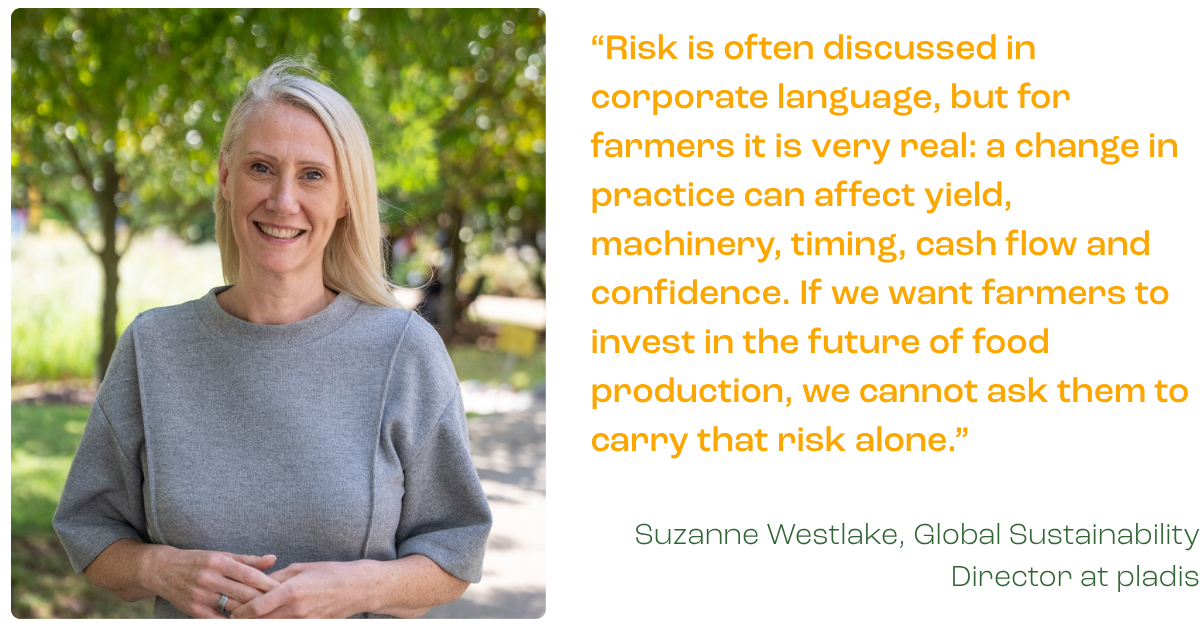
Risk is often discussed in corporate language, but for farmers it is very real: a change in practice can affect yield, machinery, timing, cash flow and confidence. If we want farmers to invest in the future of food production, we cannot ask them to carry that risk alone.
That means buyers and brands need to look harder at how procurement supports transition. Longer-term relationships, clearer demand signals, recognition for measurable progress and access to the right agronomic advice all matter. In Back to Farm, the broad set of actions is important because it recognises that every farm starts from a different place. A flexible programme is more likely to build confidence because it allows growers to make changes that are right for their land and their business, not just for a corporate target.
Partnerships as a building stone for resilience
Suzanne Blake, WCF:
WCF’s role is to create space for companies, technical experts, origin partners and others to learn from each other, because no one actor has the full solution. pladis works with expert partners across different ingredients and regions. Why is that partnership model so important?
Suzanne Westlake, pladis:
One of the lessons I keep coming back to is that we do not have to pretend to be the experts in everything. We are a snacking business; farmers and agricultural partners understand farming. Our role is to be a serious partner: to bring demand, long-term commitment, commercial discipline and a willingness to listen.
That only works when the partnership is honest enough to be tested. Frontier challenged us to make Back to Farm practical for farms of different sizes and levels of maturity, and that challenge made the approach stronger. The same principle runs through our work in other ingredients. In Türkiye, Beyond Hazelnut supports producers in the Black Sea region, including women farmers, with regenerative practices, productivity and rural development. Our Aliağa Biscuit Wheat work shows how scientific collaboration can support drought-resistant varieties. Different crops need different models, but the common denominator is partnership and local expertise.
Shared expertise benefits the sector
Suzanne Blake, WCF:
For cocoa, resilience includes farmer livelihoods, climate adaptation, forest protection, disease pressure, market stability and long-term supply. The realities are specific to each origin and landscape, but the need for stronger collaboration is shared across the sector. What lessons from the wider regenerative agriculture discussion are relevant for cocoa?
Suzanne Westlake, pladis:
Cocoa is a good example of why we need both ambition and humility. The challenges in cocoa are complex: farmer livelihoods, land use, deforestation risk, climate resilience, community investment and long-term supply security are all connected. Targeted programmes like Beyond Cocoa are valuable because they help us learn what works at farmer and co-operative level, but they are only one part of the answer.
The bigger question is how we scale impact beyond individual projects. That is where organisations such as Earthworm matter: they help bring a landscape and community lens, not just a commodity lens. In practice, that means investing in the local conditions that allow cocoa farming communities to adapt over time, while also improving visibility and confidence in supply. For me, resilient cocoa is not only about securing a crop; it is about strengthening the communities and ecosystems that the crop depends on.
From London Climate Action Week to action
Suzanne Blake, WCF:
A recurring theme in WCF’s work with members is that ambition only matters if it can be translated into practical action with farmers, partners and producing countries. Looking back at London Climate Action Week, what is your main takeaway on how the sector can action these goals and boost genuine partnerships?
Suzanne Westlake, pladis:
My main takeaway from London Climate Action Week was that the sector is ready to move from ambition to execution. The challenge now is to make regenerative agriculture easier to participate in, easier to finance, easier to evidence and easier to scale.
For pladis, that means Happy People, Happy Planet as a strategic framework, not a slogan. It brings together responsible sourcing, carbon, nature, communities and long-term resilience. But the way we deliver it has to stay grounded in partnership: with farmers, with expert organisations and with the wider supply chain.
If we get that right, regenerative agriculture becomes more than a sustainability project. It becomes a way to build a stronger food system: one that supports farmers, protects the landscapes we depend on and gives businesses like ours greater confidence in the ingredients behind our brands.
For the cocoa sector, the message from London Climate Action Week is clear: regenerative agriculture cannot scale through isolated action alone. It needs practical collaboration, stronger partnerships and a more honest conversation about how risk is shared. For WCF and its members, this is where collective work matters most, because resilient cocoa depends not only on better practices, but on the systems that make those practices possible.