
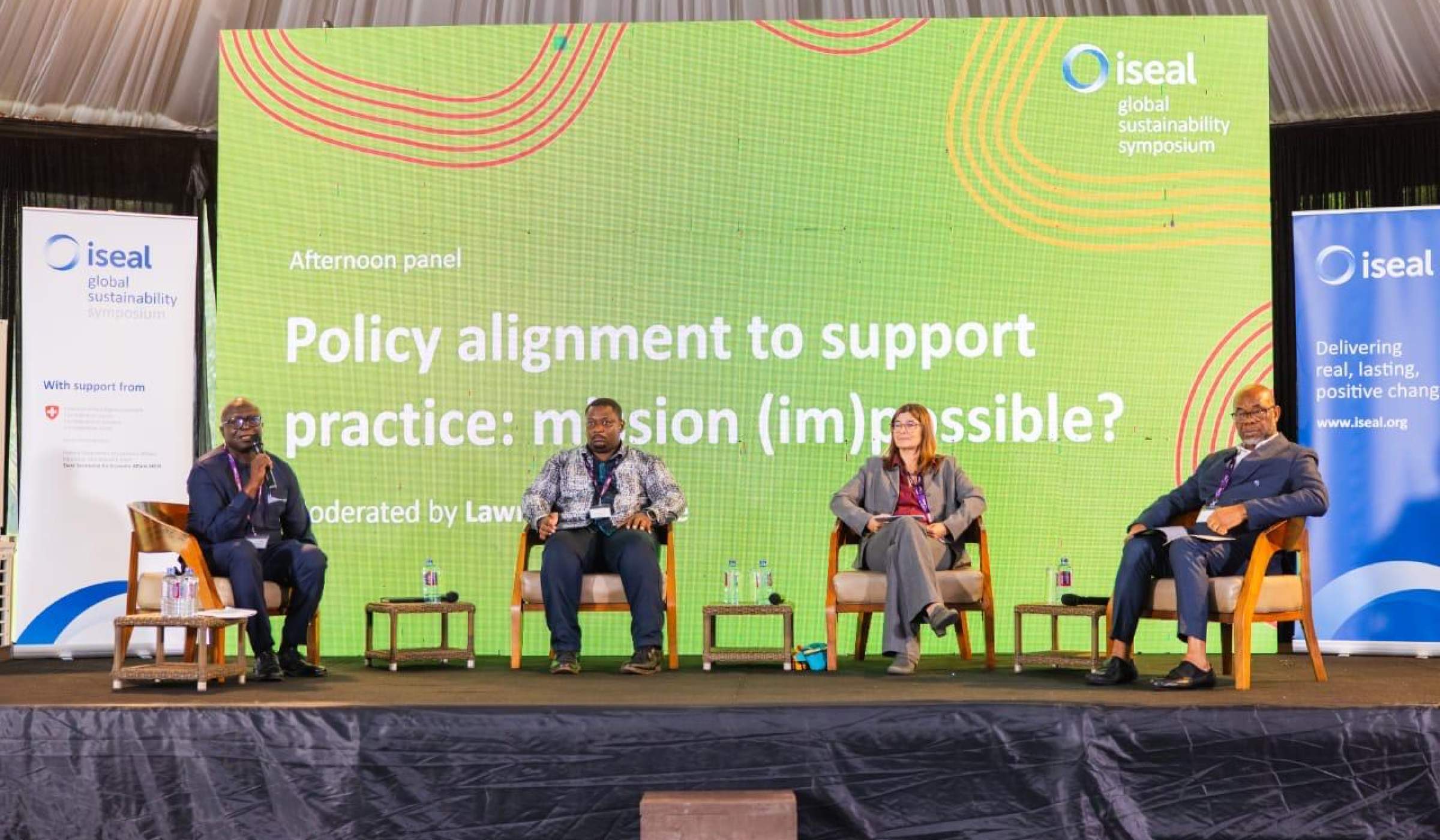
Drawing on insights from the ISEAL Global Sustainability Symposium, Dr. Coffie Mawuli explains why cocoa resilience begins with farm economics.
The future of the cocoa supply chain can be read in the choices made on a small farm: whether to buy inputs now or wait, whether to remove diseased trees, whether to borrow for rehabilitation, whether cocoa still offers enough income to justify another season of work. These are household decisions, but they carry consequences far beyond the farm. When enough farmers begin to doubt the economics of cocoa, the risk travels through local markets, national production systems and global supply chains.
In Ghana - and across West Africa, farmers are making these choices under demanding conditions. Climate variability is changing the reliability of yields and the timing of farm management. Ageing trees reduce productivity and raise the cost of keeping farms viable. Cocoa Swollen Shoot Virus Disease can take productive trees out of use for years. Inputs cost more. Buyers and regulators are asking for stronger traceability, better data and proof of compliance. Many farmers still earn below what is required for a decent standard of living.
The pressure is not experienced as separate problems. A farmer facing disease still needs income. A farmer asked to replant still needs finance. A farmer expected to provide data still needs a reason to participate in the system asking for it. A farmer managing climate risk still needs labour, tools and confidence that cocoa will remain worth investing in.
Cocoa Swollen Shoot Virus Disease shows the economics of resilience with particular force. Removing infected trees may be necessary to protect future production, but for the farmer it also means losing income now. Replanting requires labour, seedlings, technical advice and financing, while full production may take years to return. A technical intervention therefore becomes a financial decision, and a financial decision becomes a question of whether a family can absorb several years of reduced earnings.
This is why living income belongs at the centre of supply chain resilience. It has rightly been treated as a development priority, but in cocoa it is also a supply question. Farmers with more predictable income can maintain farms before they decline, buy inputs at the right time, rehabilitate trees, hire labour and recover after disease or extreme weather. They can make longer-term decisions about cocoa as a business, rather than treating each season as a test of survival.
Low income narrows the field of action. Farm maintenance is delayed because cash is needed elsewhere. Approved inputs are used too late, or not at all. Replanting waits because the return is too distant. Compliance requirements, even when necessary for market access, can feel like another cost if they are not connected to better services, stronger market opportunities or practical support. The result is a farm economy with little room to invest, recover or plan.
Improving farmer economics requires the systems around the farmer to reinforce one another. Governments shape the conditions through pricing policy, land and forest governance, disease control, extension services and national traceability systems. Companies shape the farm economy through sourcing relationships, sustainability programmes, market incentives and data requirements. Financial institutions influence whether farmers can invest before returns are visible. Researchers and technical partners determine whether new planting material, diagnostics and farm guidance are credible and usable. Farmer organisations carry the local trust and delivery capacity without which many programmes remain distant from the people they are meant to serve.
Each actor holds a different lever, and the levers only matter when they move in relation to the same farm-level reality. A disease programme with no financing leaves farmers with a recommendation they cannot afford. A traceability system with no farmer benefit turns information into burden. A productivity target without attention to input costs, ageing trees or labour availability misses the conditions that determine whether a farmer can act. A market requirement without alignment across companies and national systems risks multiplying the same data collection exercises on already thin margins.
Credible systems are still necessary. Traceability, farmer data, land-use information, monitoring and transparent reporting help cocoa remain connected to high-value markets. They also help governments, companies, consumers and investors understand how cocoa is produced. Yet farmers are often the first source of the information these systems require. If a farmer is asked for farm boundaries, production records, household data and compliance documentation, the system should return value through market access, services, finance or better decisions.
Finance deserves particular attention because cocoa investment moves on a different clock from many lending models. A farmer who removes diseased trees may wait years before full production returns. Rehabilitation and replanting require capital before income recovers. Short-term credit can be poorly matched to this cycle. Farm renewal calls for financing that recognises delayed returns, shares risk and treats the protection of future supply as an investment rather than a cost.
It is similar in research research. Farmers adopt practices they can trust, and trust is built through evidence from conditions they recognise. A recommendation developed far from the realities of smallholder cocoa farms may fail not because the science is weak, but because the route from research to use is incomplete. Disease management, climate adaptation and productivity improvements need field validation, delivery channels, farmer organisations and support systems capable of turning advice into action.
This is where WCF’s convening role shows impact. Member companies, governments, researchers, financial partners and farmer organisations each see a different part of the cocoa economy. Bringing those perspectives together helps identify where the system breaks down: where disease surveillance fails to connect to rehabilitation, where traceability requirements add cost without value, where finance does not match farm recovery, where data is collected but not used to improve decisions.

The goal is not to place more demands around farmers, but to make the systems work toward the same outcome: cocoa farming that remains productive, viable and worth investing in.
Supply chain resilience begins with the farmer’s ability to keep cocoa as a credible economic choice. If farms remain productive, if farmers can recover from shocks, if young people can see a future in the crop, the supply chain has a foundation on which to build. If those conditions weaken, resilience becomes a promise made far from the farm and tested where the risks are carried first.